MEXC Review: Fees, Who's Behind It and Security, Tested Hands-On
lowest fees · widest altcoin selection

 Users
40M+
Users
40M+
 Coins
1690+
Coins
1690+
 24h volume
$16B
24h volume
$16B
 Min deposit
$10
Min deposit
$10
MEXC Overview
→ with MX (−20%)
- Zero spot maker fees — only major exchange with 0% across all pairs, lowest taker too
- 2,000+ coins (3,000+ pairs) — largest catalog among major exchanges, fastest listings
- Stacking fee discounts — 20% with MX + 20% with referral, rising with VIP level
- Hacken-audited Proof of Reserves — BTC 135%, no major hacks since 2018
- Top-rated app — 4.7 iOS / 4.6 Android, full feature parity
- Trustpilot 1.8/5 — frozen account complaints and slow support resolution
- White Whale dispute (August 2025) — ~$3M frozen, resolution disputed, resurfaced Jan 2026
- No tier-1 license — on FCA warning list, Estonian VASP revoked 2023, warnings from BaFin/ASIC/SFC/FSA
- No direct fiat banking — SEPA, SWIFT, ACH not supported for deposits or withdrawals
- Restricted in major markets — not available in US, Canada, Singapore, China, Hong Kong
- Complex interface for beginners — product breadth overwhelming vs Coinbase or Kraken
MEXC is a centralized crypto exchange founded in April 2018 in Seychelles, known for some of the lowest fees in crypto (0% spot maker), the largest token catalog among major exchanges, and fast listings of new tokens. It reports 40M+ users across 170+ countries and 48 languages, and it has no publicly reported major breach with user-fund losses since launch. The other side: it operates offshore with no tier-1 license and sits on the UK FCA's warning list. We tested registration, fees, deposits, futures trading, and withdrawals end to end before writing this review.
Our verdict: 7.0/10 — the lowest fees and the biggest altcoin catalog in crypto, with a regulatory profile and a 1.8 Trustpilot score that decide who it's for.
Fees, and what you'll actually pay
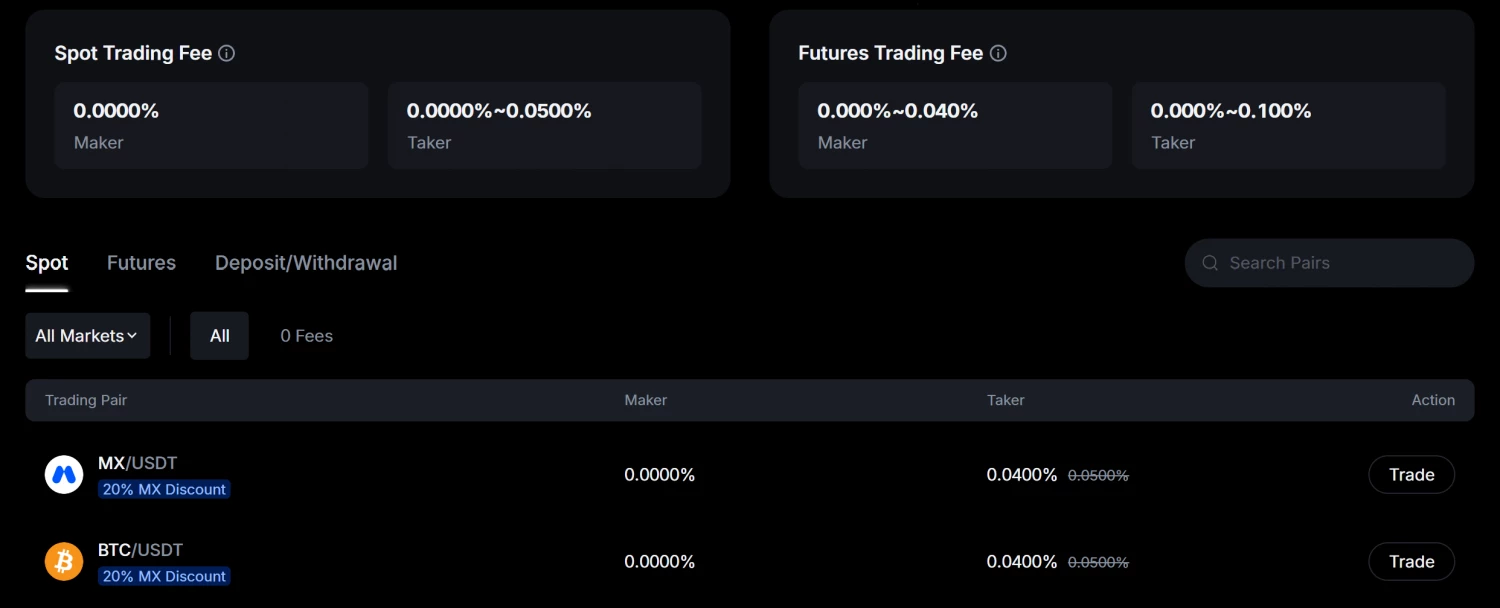
MEXC's biggest competitive advantage is fees. Spot maker is 0%; from there it depends on your tier and active discounts. On our account with MX deduction on (−20%): spot is 0% maker / up to 0.05% taker, futures up to 0.04% maker / up to 0.1% taker. For comparison, Binance, Bybit, KuCoin, BingX, and Bitget all charge 0.10% on both sides of a spot trade.
The interesting part is how the discounts stack. Paying fees with the MX token takes 20% off (the interface labels it "Deduct using MX — 20% Off"). If your account was registered with a referral code, another 20% comes off on top. The two stack, pushing the entry-level taker well below the headline rate. At high VIP levels (by 30-day volume or MX held), the discount reaches 50%.
| Exchange | Spot Maker / Taker | Futures Maker / Taker | Native token discount |
| MEXC | 0% / 0.05% | 0.04%/ 0.10% | 20% MX |
| Binance | 0.10% / 0.10% | 0.02% / 0.05% | 25% (BNB) |
| Bybit | 0.10% / 0.10% | 0.02% / 0.055% | none |
| Bitget | 0.10% / 0.10% | 0.02% / 0.06% | 20% (BGB) |
| BingX | 0.10% / 0.10% | 0.02% / 0.05% | none |
| KuCoin | 0.10% / 0.10% | 0.02% / 0.06% | 20% (KCS) |
A $1M monthly futures volume runs roughly $320–400 on MEXC (with MX and a referral code) versus $550 on Bybit (0.055%). Withdrawal fees are reasonable too: BTC native around 0.00002 BTC (~$2), BTC on BEP-20 just ~$0.60, USDT on TRC-20 around 1 USDT, and USDT on BSC notably free. The fee gap is genuine, and no other major exchange comes close.
Security, track record and current state
MEXC has no publicly reported major exchange-wallet hack with user-fund losses on record since its April 2018 launch. It keeps 95% of funds in cold wallets, maintains a $100M+ Guardian Fund reserve, holds a CertiK AA rating, and publishes regular Proof of Reserves independently verified by Hacken.
Reserve ratios as of January 2026 were above 100% across the board (BTC 135%, USDT 130%, USDC 124%, ETH 105%). The independent Hacken audit is a real plus, since some competitors self-attest their PoR. Users can verify individual balances through Merkle-tree proofs. Authentication covers Google Authenticator, SMS, hardware keys, FIDO passkeys, and biometrics, with anti-phishing codes and withdrawal whitelists available.
Regulation and user reviews
The unresolved concerns aren't technical, they're operational and regulatory.
The widely discussed "White Whale" dispute (August 2025): a trader's account holding around $3M was frozen, with MEXC reportedly requesting an in-person KYC check in Malaysia before releasing the funds. It went viral, the resolution stayed disputed with no clear public outcome, and it resurfaced in January 2026 with fresh allegations. It fits a recurring pattern in user reviews: freezes under vague "compliance" or "security review" justifications, slow communication, and unclear timelines. Trustpilot sits at 1.8/5, with that complaint dominating one-star reviews.
On regulation, the picture is thin, and it got thinner in 2026. MEXC holds no tier-1 license: Estonia revoked its VASP registration in November 2023, and in May 2026 the Seychelles FSA — the regulator of MEXC's own home jurisdiction — publicly stated that operator MX Global Ltd runs the exchange without the required licence. It sits on the UK FCA's warning list, with public warnings from Germany's BaFin, Australia's ASIC, Hong Kong's SFC and Japan's FSA. What it does hold is AML-level registration: AUSTRAC in Australia and FIU-IND in India.
Verification and limits
MEXC used to be known for letting you trade without verification. That's over: as of February 1, 2026, KYC is fully mandatory. Without a verified identity, deposits, withdrawals, and trading are restricted — everyone verifies now.
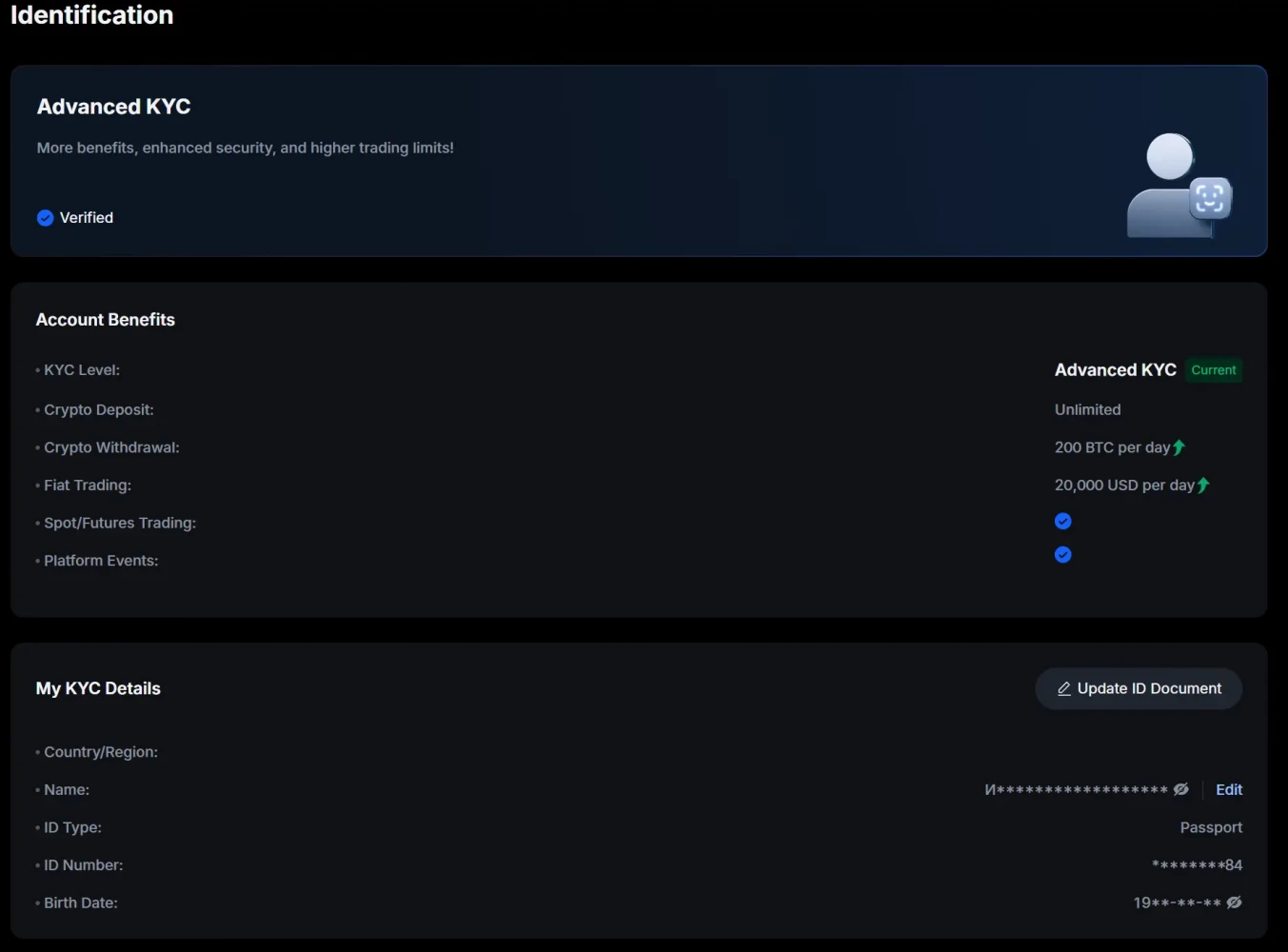
There are two levels. Primary KYC (passport or ID + selfie) raises the daily withdrawal limit to 80 BTC and unlocks basic access. Advanced KYC adds facial recognition and proof of address: 200 BTC/day withdrawal, up to 20,000 USD/day fiat trading, and unlimited crypto deposits. Verification usually takes minutes to a couple of hours, occasionally longer. Institutional accounts go up to 400 BTC/day.
Deposits: crypto across 30+ networks (free, credited after confirmations) and card via Visa or Mastercard (2-4% third-party fees). P2P supports local payment methods. The one persistent gap: no direct SEPA, SWIFT, or ACH for deposits or withdrawals (the same limitation as BingX). To reach a bank account, you sell via P2P or move funds to a fiat-friendly exchange.
Tools and products
MEXC is more than spot and futures — it's a full toolkit, and several of these are genuinely useful if you trade actively.
- Earn. A passive-income hub: flexible savings (withdraw anytime), fixed-term products, and staking. Launchpool lets you stake MX or another asset to earn tokens from new projects. Handy for parking idle funds.
- Launchpad. Subscription-based token sales of vetted projects: commit MX, USDT, or another supported asset for an early allocation, often well below listing price. Requires Advanced KYC, and sometimes a minimum deposit or trading volume.
- Kickstarter. Pre-listing voting with token rewards. You commit MX (from 5 up to 100,000); the tokens lock for a few hours and return to you, while you collect free airdrops of new projects. In effect, long-term MX holders earn a steady stream of new altcoins for nothing.
- Copy trading. Mirrors verified traders' futures positions in real time, with profit-sharing and a public leaderboard. A way into derivatives without building a strategy from scratch.
- DEX+ and Meme+. DEX+ lets you trade on-chain tokens (Solana, Base, BSC memecoins) straight from the MEXC interface, with no separate wallet or gas hassle. Meme+ is a dedicated zone for early memecoins and trending tokens. This is where MEXC's signature speed shows: new listings often appear before they reach tier-1 venues.
- Leveraged ETFs and loans. Tokenized leveraged ETFs (BTC3L, ETH3S and similar) give amplified exposure without liquidation risk — simpler than futures. Crypto loans let you collateralize one asset to borrow another.
- Demo with 50K virtual USDT. A risk-free sandbox for both perpetual and standard futures, especially worthwhile given MEXC's up-to-500x leverage.
The MX token threads through all of it: fee discounts, Launchpool access, Kickstarter priority, boosted staking. It's an Ethereum ERC-20 with a buyback-and-burn model that has cut the circulating supply well below the original issuance.
What MEXC does better
- Lowest fees. 0% spot maker, and with stacked discounts (MX + referral) the taker drops well below the headline rate. For high-volume traders, that's thousands a year.
- Largest catalog. 2,000+ coins versus 400-900 at peers, with new tokens often live within hours of launch.
- Listing speed. Pre-Market, Meme+, and DEX+ give access to trending tokens before tier-1 exchanges.
- Top-tier app. 4.7/5 on iOS and Android, higher than Binance, KuCoin, BingX, Bitget, and HTX, with full web parity.
Where MEXC falls short
- Trustpilot 1.8/5. Complaints cluster around account freezes and unclear timelines; the White Whale case (August 2025) is the loudest example.
- Weak regulatory footprint. No tier-1 license — FCA warning list, Estonian licence revoked 2023, Seychelles FSA alert 2026.
- No direct fiat banking. No SEPA, SWIFT, or ACH — only P2P or a transfer to another exchange.
- Country restrictions. Unavailable in the US, Canada, Singapore, mainland China, Hong Kong, and sanctioned regions.
- Steep for beginners, thin small-cap liquidity. The product breadth overwhelms at first, and real size on obscure tokens moves with slippage.
How MEXC compares
| If you care most about… | Best choice | Why |
| Lowest possible fees | MEXC | 0% spot maker plus stacked discounts |
| Widest altcoin selection | MEXC | 2,000+ coins vs 400-900 at peers |
| Early access to new tokens | MEXC | Listings ahead of tier-1 exchanges |
| Liquidity & fiat on-ramps | Binance | Highest global volume, broadest fiat support |
| Clean public custody-hack record | Bitget or MEXC | Both clean since 2018, but Bitget runs a larger protection fund than MEXC's $100M Guardian Fund |
| Regulatory consistency | Bybit | Tier-1 licenses (MEXC has none) |
| Lower operational-friction risk | Binance or Bitget | Fewer high-profile freeze disputes than MEXC |
Bottom line
7.0/10. The lowest fees in crypto and the largest altcoin catalog make MEXC a strong specialty exchange for active traders. Holding it back are the Trustpilot 1.8/5, the freeze pattern, and a thin regulatory profile; for long-term storage, Binance or Bitget are safer.