Binance Review: Fees, Liquidity and Regulation, Tested Hands-On
low fees · deep liquidity

 Users
300M+
Users
300M+
 Coins
820+
Coins
820+
 24h volume
$45B
24h volume
$45B
 Min deposit
$5
Min deposit
$5
Binance Overview
→ with BNB (−25%)
- World's largest exchange — 300M users, $34T 2025 volume, 41% global spot share
- Deepest liquidity in crypto — minimal slippage even on million-dollar orders
- Largest insurance fund in industry — $1B SAFU vs Bitget $780M, OKX $700M, MEXC $100M
- 820+ coins, 1,889+ trading pairs — widest selection among regulated platforms
- BNB token 25% spot discount — stackable with VIP tiers and referral codes
- Highest mobile app rating — 4.8/5 iOS, 4.7/5 Android (top in category)
- $4.3B DOJ settlement November 2023 — largest in crypto history, FinCEN compliance monitor until 2028
- No MiCA license — EEA services suspended since July 1, 2026; Greek application withdrawn, re-filing planned
- US blocked on Binance.com — Binance.US severely limited (~160 coins, no futures, missing states)
- Trustpilot 1.6/5 — lowest among major exchanges, slow support response
- 2019 hack $40.7M — fully recovered via SAFU but historical record
- Restricted in major markets — EEA suspended, Canada blocked, UK partial, Nigeria suspended
Binance is the world's largest cryptocurrency exchange: 300M+ registered users across 100+ countries, around $34 trillion in 2025 trading volume, and roughly 41% of the global spot market. Founded in 2017 by Changpeng Zhao (CZ), it offers 820+ cryptocurrencies, futures with up to 125x leverage, the industry's largest insurance fund (the $1 billion SAFU), and one of the highest-rated mobile apps among major exchanges (4.8/5 on iOS). Following the $4.3 billion DOJ settlement in November 2023, Binance operates under a five-year FinCEN compliance monitor through 2028. Since July 1, 2026, services for EEA users are suspended — Binance missed the MiCA deadline after withdrawing its Greek application and plans to re-file elsewhere. We tested registration, fees, deposits, futures, and the Web3 wallet end to end before writing this review.
Our verdict: 8.0/10 — the deepest liquidity and the broadest product suite in crypto, with the $4.3B settlement history and closed doors for US and EEA readers deciding the score.
Fees, and what you'll actually pay
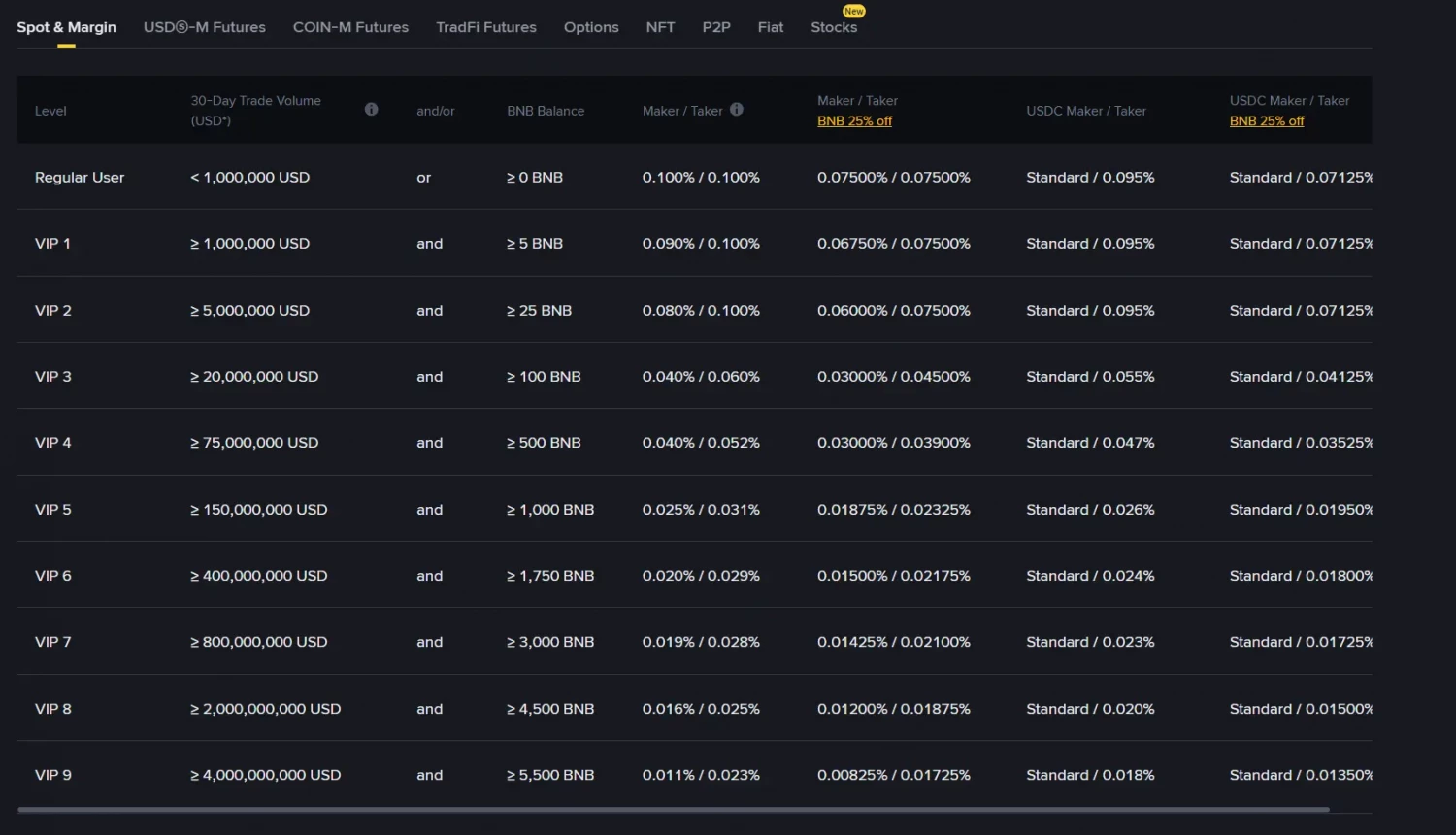
Binance charges 0.10% maker / 0.10% taker on spot at the base tier, the industry default, identical to Bybit, KuCoin, BingX, and Bitget. The differentiator is the BNB discount: hold BNB and enable "Pay fees with BNB" to cut spot fees by 25%, to 0.075%, below OKX's 0.08% base maker.
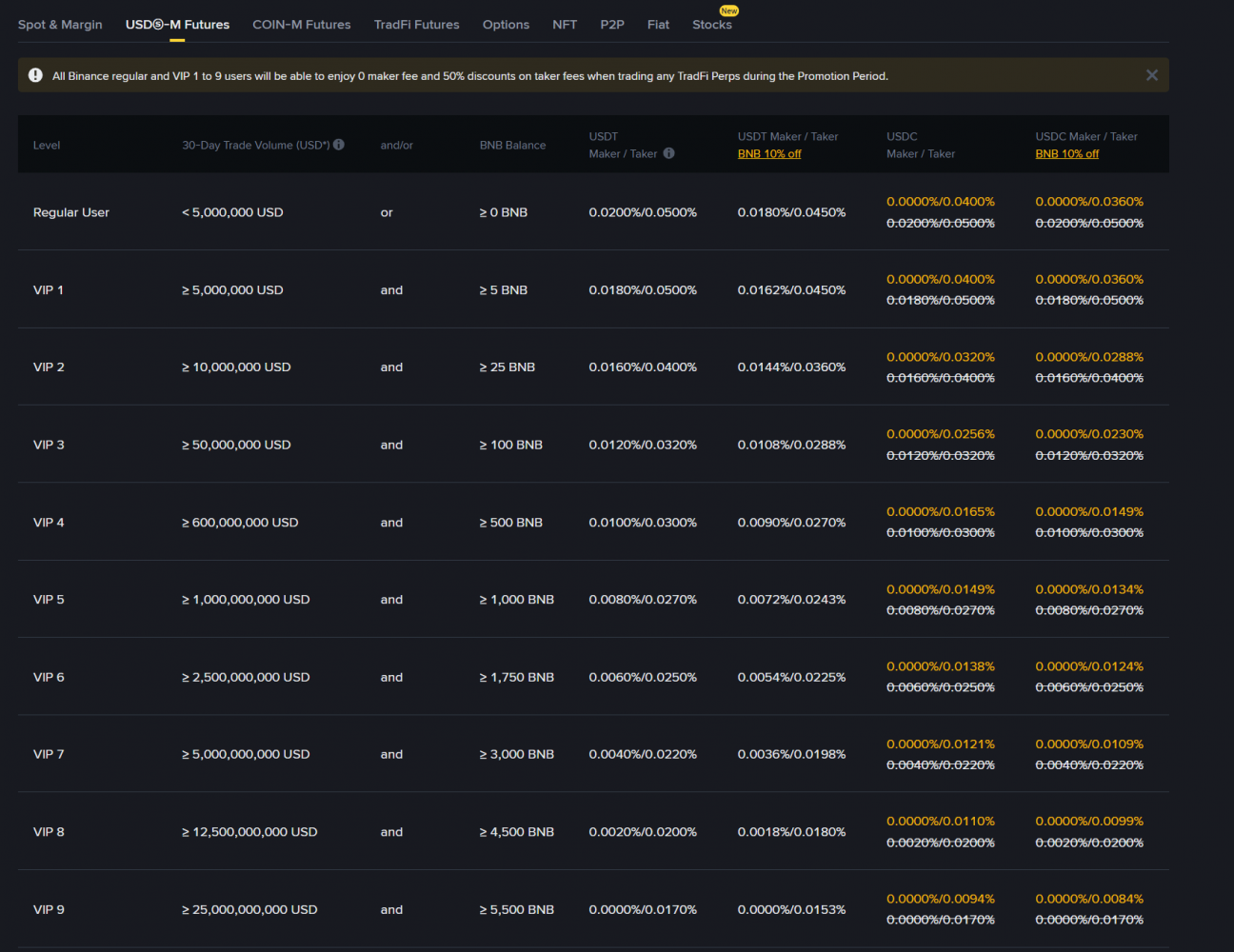
Futures fees are 0.02% maker / 0.05% taker, matching OKX and BingX and lower than Bybit (0.055%), Bitget (0.06%), and KuCoin (0.06%). The BNB discount on futures is 10%. VIP tiers cut both further; at the top tiers, spot maker approaches 0.025% and futures maker reaches 0%.
One nuance worth knowing: signing up with a referral code cuts both spot and futures fees by 20% versus the standard rate, before the BNB discount is even applied, and the two stack.
| Exchange | Spot Maker / Taker | Futures Maker / Taker | Native token discount |
| Binance | 0.10% / 0.10% | 0.02% / 0.05% | 25% (BNB) |
| OKX | 0.08% / 0.10% | 0.02% / 0.05% | up to 40% (OKB) |
| Bybit | 0.10% / 0.10% | 0.02% / 0.055% | 25% (MNT) |
| Bitget | 0.10% / 0.10% | 0.02% / 0.06% | 20% (BGB) |
| BingX | 0.10% / 0.10% | 0.02% / 0.05% | none |
| KuCoin | 0.10% / 0.10% | 0.02% / 0.06% | 20% (KCS) |
| MEXC | 0% / 0.05% | 0.04% / 0.10% | 20% (MX) |
Maker/taker at standard public rates, before native-token and campaign discounts.
Stackable discounts. With the referral discount (20%), the BNB discount (25%), and VIP 1 status, an active trader can reach roughly 0.054% effective spot maker, which narrows the practical gap with MEXC's 0% maker once Binance's deeper liquidity (better fills) and lower slippage are factored in.
Withdrawal costs depend on the network far more than on the exchange. USDT over BSC runs about 0.3 USDT and TRC-20 about 1 USDT, while ERC-20 can hit 5-10 USDT. For BTC, BEP-20 costs cents and Lightning about a dollar; the native network is the expensive route. Most withdrawals clear within 30 minutes. The rule from our other reviews holds: pick the network before you pick the exchange.
The honest fee picture: Binance is among the cheapest major exchanges once BNB stacking and VIP tiers are in play. MEXC undercuts it on raw spot fees (0% maker), but its futures base (0.04%/0.10%) runs higher, and Binance's liquidity advantage typically saves more on slippage than the fee gap costs.
Security, track record and current state
Binance's security infrastructure is the most extensive in crypto by spend and scope. It stores the majority of user funds in cold storage, maintains the $1 billion SAFU fund (the largest user-protection reserve in the industry), publishes Proof of Reserves with Merkle Trees and zk-SNARK cryptographic verification, and runs real-time AI risk monitoring.
Reserve transparency: Binance reports about $153 billion in verified user assets (April 2026) across 45 crypto assets, kept on a separate ledger from corporate holdings, with zero debt in its capital structure. Users can verify individual balance inclusion through Merkle Tree proofs on the website.
Authentication covers Google Authenticator, SMS, hardware keys, FIDO passkeys, biometrics, anti-phishing codes, withdrawal whitelists, and login notifications. Account-level security is on par with major banks.
The 2019 hack: on May 7, 2019, attackers stole 7,000 BTC (about $40.7 million) from Binance's hot wallet via an API key compromise, roughly 2% of its BTC holdings at the time. Every dollar was covered from the SAFU fund, with zero user losses, and withdrawals were paused for a week while security was upgraded. It remains the only successful hack of the exchange itself, and no publicly reported breach has cost exchange users funds since: a clean run of about seven years.
The SAFU fund: built from 10% of trading fees. In February 2026 Binance finished converting it into 15,000 BTC — about $1 billion at an average purchase price near $67,000 — with a public on-chain address and a pledge to refill the fund if its value drops below $800 million. The fund now lives in BTC, so its dollar value moves with the market.
The major regulatory event: in November 2023, Binance pleaded guilty to three charges, conspiracy to violate the Bank Secrecy Act, operating an unlicensed money-transmitting business, and willful violation of US sanctions laws. The total settlement was $4.3 billion. CZ resigned as CEO, served four months in prison, and received a presidential pardon in October 2025. Richard Teng (formerly of the Monetary Authority of Singapore) became CEO in November 2023. Binance now operates under an independent FinCEN-appointed compliance monitor through 2028.
The honest assessment: the settlement was the largest in crypto history, but the resulting compliance framework, with active US Treasury oversight through 2028, arguably makes Binance more accountable than before. The $1B SAFU fund and the clean post-2019 hack record are real strengths. For users who read ongoing US government oversight as a positive trust signal, Binance's post-settlement posture is industry-strong.
Verification, deposits, and getting started
Binance requires mandatory KYC for all account activity: trading, deposits, and withdrawals all need at least basic verification. That matches OKX and Bitget and is more restrictive than MEXC, BingX, or Bybit. Basic (government ID + selfie) unlocks $50,000/day fiat withdrawal; adding proof of address raises it to $2M/day; source-of-wealth documentation goes above that. Approval usually takes 5–30 minutes.
Deposits cover crypto across 50+ networks (free, instant after confirmations), card via Visa/Mastercard/Apple Pay (~2% third-party fees), bank transfer (SEPA, SWIFT, ACH via Binance.US, Faster Payments), and P2P with local methods and zero buyer fees. The minimum deposit is just $5, and Binance offers the broadest fiat on-ramp infrastructure of any global exchange.
What Binance does better
- Deepest liquidity in crypto. Daily volume runs from roughly $12B to $217B across spot and derivatives, so large orders fill at marginal slippage. For traders moving size, that edge often outweighs the fee gap with cheaper venues like MEXC. Across our eight-exchange comparison, Binance leads on orderbook depth.
- Largest insurance fund in the industry — $1B SAFU (15,000 BTC) vs Bitget ~$440M, OKX $700M, MEXC $100M.
- Wide product and coin selection. 820+ coins and 1,889+ pairs: spot, perpetual futures (USDT-M, COIN-M, USDC-M), options, margin, copy trading, bots, P2P, an NFT marketplace, a Web3 wallet, Launchpad/Launchpool, and a deep Earn suite.
- BNB ecosystem. BNB gives 25% off spot and 10% off futures, plus Launchpad and Launchpool access, and it's the gas token for BNB Chain, so it carries demand drivers beyond exchange utility that most native tokens lack.
- Highest app rating in the category. 4.8/5 iOS and 4.7/5 Android, the best combined rating among major exchanges, with full feature parity and a Lite Mode for beginners.
- Web3 wallet without a seed phrase. Binance's MPC-based wallet uses keyless recovery, integrating 29 DEXs and 15 bridges. OKX's wallet leads on chain count (130+) and aggregator depth (400+ DEXs), but the seed-phrase-free design is a real UX win for retail users.
Where Binance falls short
- The $4.3B DOJ settlement is the largest in crypto history. Binance pleaded guilty to Bank Secrecy Act violations and unlicensed money transmission, CZ stepped down, and the exchange runs under a FinCEN monitor through 2028. The post-settlement posture is strong, but the violations are a permanent record. Bitget still has the cleaner major-incident and regulatory record.
- EU access: suspended. Binance withdrew its Greek MiCA application on June 24, 2026 — days after reports the regulator would reject it over the fit-and-proper test — and missed the July 1 deadline. EEA accounts are limited to closing positions and withdrawing; new signups, orders, and deposits are off. Binance says it will re-apply through another member state and return "in the coming months," with no date and no country confirmed. Meanwhile OKX, Bybit, Coinbase, Kraken, and Crypto.com hold licenses and are taking the migrating users.
- US users get a different platform. Binance.com is blocked for Americans; Binance.US is a separate entity with only ~160 coins (vs 820+ globally), no futures, no margin, and limited Earn. It's also unavailable in New York, Texas, Hawaii, Idaho, Louisiana, and Vermont. The SEC lawsuit was dismissed with prejudice in May 2025, but the feature gap remains. OKX (46 states, full spot, Web3 wallet) is the stronger US option.
- Trustpilot 1.6/5, the lowest in our eight-exchange comparison. Complaints cluster around slow support, difficulty escalating past the AI chatbot, verification holds, and withdrawal-review delays. At 300M+ users, support is structurally hard, but the gap with smaller rivals (MEXC 1.8, Bybit 3.3) suggests a real issue.
- Restricted in major markets. Beyond the US, Binance.com is fully blocked in Canada and sanctioned countries, and partially restricted in the UK (no FCA approval; no lending/staking), Australia (futures halted by ASIC), Japan (spot only via a licensed entity), Nigeria (suspended; lawsuit pending), the Netherlands, and Belgium.
- The 2019 hack happened. $40.7M was stolen via a hot-wallet API compromise and fully covered by SAFU, with a clean record since, but Bitget, MEXC, and OKX carry cleaner histories.
How Binance compares
| If you care most about… | Best choice | Why |
| Liquidity and orderbook depth | Binance | Deepest in crypto, minimal slippage on large orders |
| Largest insurance protection | Binance | $1B SAFU (15,000 BTC) vs Bitget ~$440M, OKX $700M, MEXC $100M |
| Widest fiat on-ramp support | Binance | SEPA, SWIFT, cards, P2P with most local methods |
| Best mobile app | Binance | 4.8/5 iOS, 4.7/5 Android (highest combined) |
| EU regulatory clarity | OKX or Bybit | Already MiCA-licensed; Binance suspended in the EEA since July 1, 2026 |
| US access among major exchanges | OKX | 46 states with full spot + Web3 (Binance.US severely limited) |
| Lowest possible fees | MEXC | 0% spot maker (futures cheap only with MX) |
| Cleanest regulatory track record | Bitget | No major regulatory actions vs the $4.3B DOJ settlement |
| Best Web3 wallet | OKX | 130+ chains, 400+ DEX aggregator |
Bottom line
Binance earns 8.0/10. Deep liquidity, the largest insurance fund, and the broadest product suite in crypto. For traders outside the US and EEA it stays the default; US users are better served by OKX, and EEA users need a licensed platform until Binance comes back.