Updated
Sep 03, 2026
Updated
Sep 03, 2026
 8 min read
 Checked regularly
The honest numbers first
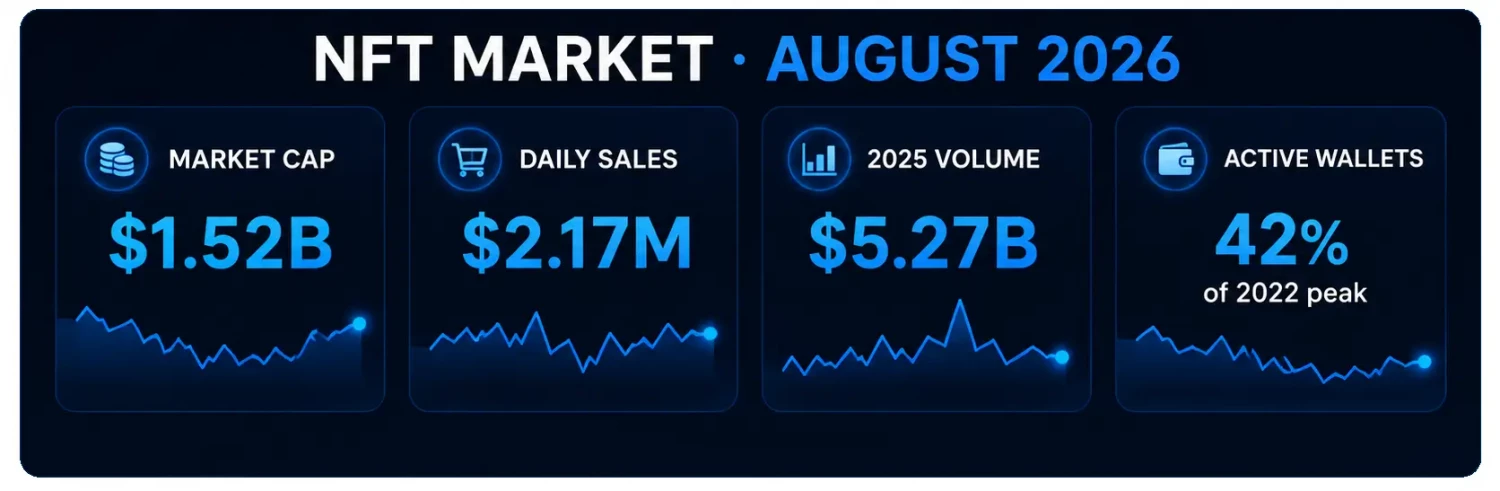
Annualized trading volume for 2025 came in around $5.5 billion, a fraction of the peak years, and 2026 has not reversed the trend, only stabilized it. The market is K-shaped in the strictest sense: a January 2026 snapshot counted only six collections out of 1,700+ with weekly volumes in the millions, and the long tail is functionally illiquid. Blur remains the professional desk of Ethereum NFT trading; Magic Eden leads Solana and Bitcoin Ordinals; OpenSea is busy pivoting into token trading, which says a lot on its own. NFT Paris, once the flagship event, was cancelled this year.
Two counter-signals keep the picture from being a plain obituary. First, people stayed: roughly 42% of the wallets active at the 2022 peak still transact, which is a durable user base, not tourists. Second, the exceptions are instructive: Bitcoin Ordinals average prices multiplied while everything else bled, Pudgy Penguins turned a JPEG collection into a retail toy brand with a floor that survived the winter, and Yuga's Otherside keeps building: the metaverse is open to walk through today, and ApeFest still brings the community together every year. What died was the middle: promises without products.
The Three Waves of NFTs
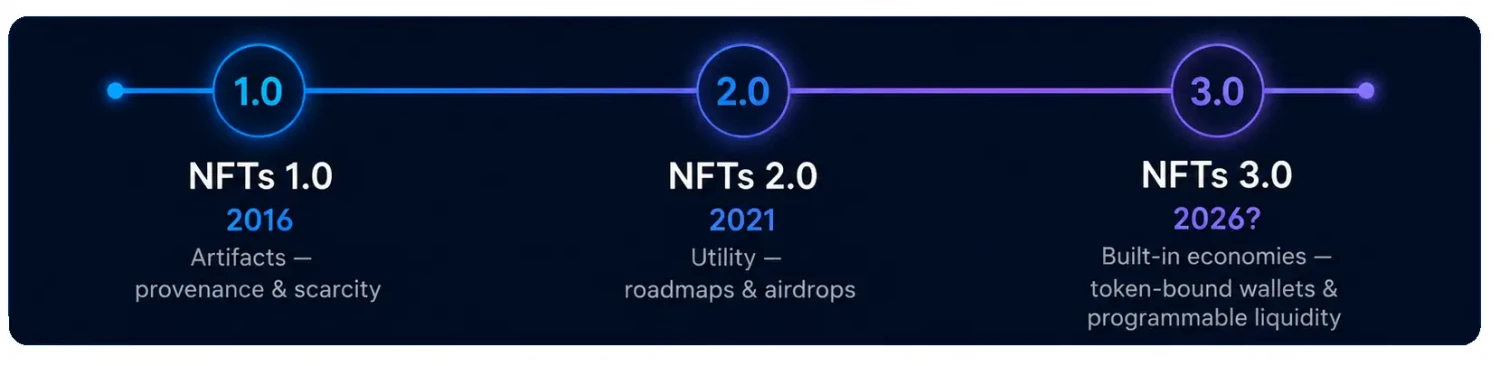
NFT history moves in waves riding the broader crypto cycle, and each wave redefined what an NFT is.
NFTs 1.0 were artifacts: early collections and digital art valued for provenance, scarcity and culture. They promised nothing, and that was the point.
NFTs 2.0 added utility: roadmaps, airdrops, companion tokens, merchandise, staking. This era built the industry as we know it, and it carried a structural flaw that took years to surface: value was created around the NFT, not through it. Brands, companies and tokens grew out of collections, and value accrues where it is created. Holders were left holding the picture while the economics lived elsewhere, enforced by nothing stronger than a promise.
NFTs 3.0, if the theory holds, is the wave where the NFT itself becomes an on-chain economic unit: it owns assets, receives value and interacts with protocols directly through smart contracts. Not a membership card for an economy that lives somewhere else, but the account the economy runs through. The pattern of a new wave every four to five years puts the timing right about now.
The Technology That Makes 3.0 Possible
Three pieces assembled quietly over the last couple of years, and none of them is vaporware.
Token-bound accounts (the ERC-6551 standard, live since 2023) give an NFT its own wallet: a picture becomes an account that can hold tokens, earn fees and own other NFTs. Programmable liquidity (Uniswap v4 hooks) lets a trading pool route fees and enforce logic by design, so value can flow somewhere automatically instead of by a team's goodwill. And two-state assets close the loop: a collection can let any NFT transform into a fixed amount of fungible tokens and back at any second, the same value in two states, one unique, one liquid.
That last piece quietly breaks the way NFTs have been analyzed for five years. When an NFT converts to tokens instantly, floor price stops being the primary metric: you no longer need to undercut the floor or wait for an offer, the token market is your exit, and the token chart is the real price of the collection. Anyone still reading these collections through floor prices and offer books is looking at the wrong dial.
A fair question follows: if any NFT converts into tokens at will, why keep the NFT at all? Because the two states do different jobs. The token is the liquid layer: the price, the exit, the thing you trade. The NFT is the container of state: the wallet it owns, the assets and accrued fees inside that wallet, the access and rights attached to it. Swap into tokens and you hold pure value; hold the NFT and you hold a position.
This is not theory on paper. Chonks on Base made token-bound accounts its core design: each character's traits are separate tokens living in the NFT's own wallet. StonkBrokers on Robinhood Chain went further: 4,444 NFTs whose wallets hold tokenized stocks and earn distributions from trading fees, with an AMM that prices every NFT at a fixed amount of the collection token. Within a month of its July 2026 launch the pegged price pushed past blue-chip floors, then corrected a quarter off the peak: demand and volatility arriving together, as they always do. More launches on the same rails are already following. The primitives now exist to make NFTs 3.0 possible; what the market has not proven yet is that anyone beyond the existing crowd wants it.
What to Watch in 2027
This is a theory, so here is what would confirm or kill it. Watch whether new collections launch with built-in economies instead of roadmaps: the difference is visible in the contract, not the marketing. Watch whether any legacy blue chips retrofit token-bound mechanics onto old collections, because that is how a niche becomes a standard. Watch whether marketplaces and analytics platforms start displaying token prices next to floors for two-state collections; the tooling always lags the mechanism.
And one signal outranks all of these: new wallets. The early 3.0 launches, clever as the mechanics are, have so far attracted the people who were already here, and capital rotating inside a niche is not a bull run. The real one starts the day a collection built on these rails pulls in users who were never in NFTs, the way 2021 did. Until then, this remains what it honestly is: a promising experiment run by and for the existing crowd.
And watch the liquidity honestly: today's market is thin enough that a small group of holders can paint any narrative, and the people promoting a wave early are usually the people positioned for it. That was true in 2021, and it is true now.
The regulatory question deserves more than a sentence. An NFT that converts into fungible tokens on demand, owns a wallet and receives fee flows looks much more like a token to a regulator than a JPEG ever did, because regulators read economic function, not pictures. The builders clearly see it: the flagship 3.0 projects already geo-fence US users out of their stock-token features and label distributions as marketing rewards, not dividends. None of it has been tested in court, and that test is a matter of time.